PRP Therapy for Erectile Function Phoenix & Scottsdale, Arizona

PRP Therapy for Erectile Function

Introduction

PRP Therapy for Erectile Function

Erectile dysfunction touches most men eventually, and almost none of them want to be the one to bring it up. What makes it harder is the noise around it. Search for a solution and you’ll find page after page of confident promises, most of them written by people who have never met you, never examined you, and never looked at your labs.

You’ll find something different here. Dr. Andersen will work out what’s actually driving the problem, walk you through which options have real evidence behind them and which don’t, and let you decide with the whole picture in front of you. PRP therapy is one of those options, and this page explains it as honestly as we know how.

A close-up portrait of a middle-aged man looking intensely to the right. He has short, styled, dark hair, light eyes, and light stubble on his chin and jawline. He is wearing a crisp white collared shirt. The background is a slightly blurred, textured gray wall. - Minimally Invasive Neck Lift in Phoenix, AZ

What is PRP Therapy?

Platelet-rich plasma comes from your own blood. We draw a small sample, concentrate the platelets in a centrifuge, and inject that concentrate into the erectile tissue of the penis. Platelets carry the growth factors your body uses for tissue repair—and the thinking behind the treatment is to deliver a high concentration of them precisely where you want them working.

Everything happens in one visit, in our office, using nothing but your own biology. There’s no donor material and no third-party product—nothing involved that didn’t come out of your arm forty minutes earlier.

How Are the Injections Performed?

Under ultrasound guidance, every time.

This matters more than it might sound. Ultrasound lets Dr. Andersen see the anatomy in real time, place the plasma precisely where he intends it to go, and avoid the vascular structures you want left alone. Most clinics offering this treatment inject by feel and landmark. As an anesthesiologist, Dr. Andersen has spent his career placing needles accurately in tissue he can see—and he brings the same standard here.

Precision doesn’t guarantee a result. It does mean the treatment is delivered the way it was designed to be—and that the margin for error is as small as we can make it.

Who Is PRP Therapy For?

PRP tends to make sense for men who:

  • Have mild to moderate erectile dysfunction
  • Prefer an autologous option, meaning one that uses their own tissue rather than a manufactured product
  • Want to try something alongside or before established treatments
  • Would rather make an informed decision than be handed a guarantee
  • Have had a proper workup, including hormone and cardiovascular evaluation

It isn’t appropriate if you have an active infection, a bleeding or platelet disorder, anticoagulation that can’t be safely paused, or an untreated underlying condition that deserves attention first.

That last point carries more weight than anything else on this page. Erectile dysfunction is frequently the first visible sign of cardiovascular disease, sometimes years before anything else shows up—so your evaluation here begins with finding out why, not with a needle.

What Are the Potential Benefits?

  • It comes from you. Autologous, prepared from your own blood, with no donor or third-party biologic material involved.
  • One visit. Draw, processing, and injection all happen in a single appointment, and you return to your normal day afterward.
  • Placed with precision. Every injection is performed under ultrasound guidance rather than by feel.
  • A favorable safety record. Published trials have reported few adverse events, most of them mild and short-lived.
  • It closes no doors. PRP combines with established treatments, and trying it rules nothing else out.
  • Measured, not guessed. We use validated questionnaires so that you and Dr. Andersen can see what actually changed rather than relying on impressions.

These are potential benefits rather than expected results, and the published randomized evidence does not establish that PRP outperforms placebo.

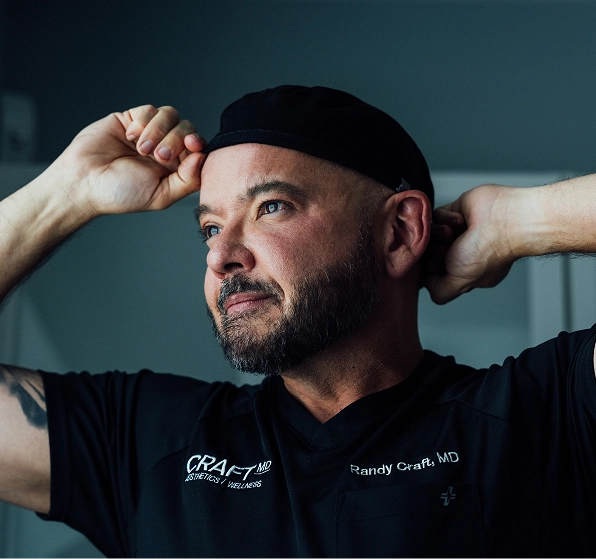
A focused, close-up portrait of Dr. Randy Craft shows him in profile, looking up and to the right with a determined expression. He is preparing for a procedure, pulling a black scrub cap over his head with both hands. He is wearing a black scrub top with the "CRAFT MD Aesthetics / Wellness" logo and his name, "Randy Craft, MD", embroidered on the chest. The background is a dim, uniform gray-blue.

What’s the First Step?

A real consultation, which means a full history, a careful medication review, appropriate labs including hormone and metabolic panels, and an honest look at your cardiovascular risk. You’ll complete a validated questionnaire so there’s an objective baseline to measure against later.

If PRP isn’t the right choice for you, Dr. Andersen will tell you so directly. Nobody in this practice is compensated for talking you into a treatment.

Background image Union

How Do I Prepare?

Stop NSAIDs and aspirin seven days before your appointment. This includes ibuprofen, naproxen, and daily low-dose aspirin. These medications interfere with platelet function, which is the entire mechanism of the treatment, so this one isn’t optional.

Never stop a prescribed medication without talking to us first. If you take aspirin or an anticoagulant for a cardiac or clotting condition, we will coordinate with your prescribing physician before making any change. Your heart comes first.

Beyond that, hydrate well the day before and the morning of, eat normally, and skip alcohol for twenty-four hours. Tell us about every supplement you take, since fish oil, vitamin E, ginkgo, and several others affect platelets as well.

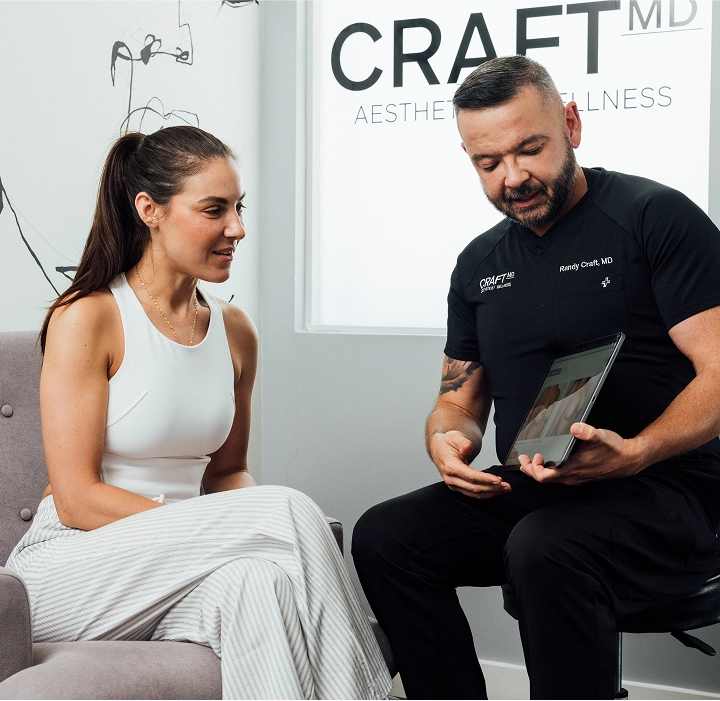
A wide shot of Dr. Randy Craft in black scrubs, sitting next to a smiling female patient, who is seated in a gray armchair. Dr. Craft is holding an open laptop and looking down at it, while the patient is looking to her left and laughing brightly. The background features a white wall with abstract black line-art of a face, and a large sign with the text "CRAFT AESTHETICS / WELLNESS" partially visible.

Recovery

Mild swelling, bruising, or tenderness over the first few days is common and expected. Hold off on sexual activity and strenuous exercise for forty-eight hours. Otherwise you’re back to normal right away.

Black and white texture background overlay
Background image Union

Being Straight About the Research

You’re going to look this up, and we’d rather you hear it from us first.

PRP for erectile function has been studied in a handful of randomized, placebo-controlled trials, somewhere around 500 men in total. Some of those trials reported meaningful improvement. Others found none. When researchers pooled only the randomized evidence—two separate analyses published in the Journal of Sexual Medicine in 2026—the combined result did not show a clear advantage over placebo, and the one randomized trial conducted in the United States came out the same way.

That’s the honest picture: encouraging individual studies, an unconvincing total. It’s why the American Urological Association still classifies this treatment as experimental, and why we use the same word.

Two other things worth knowing. Follow-up in these trials runs to six months, so nobody has measured what happens after that; if you’ve seen a clinic promise a year or more, that number didn’t come from research. And PRP isn’t FDA approved for erectile function, so this use is off-label.

So why offer it at all? Because it comes from your own blood, because the safety record in published trials has been good, and because a fair number of men who understand all of the above still want to try it. That’s a reasonable decision to make with your eyes open—and it’s equally reasonable to start with something that has stronger evidence behind it. Dr. Andersen will tell you which he’d suggest for you.

What Are the Risks?

  • Bruising, swelling, and injection site tenderness, usually resolving within days
  • Bleeding or hematoma
  • Infection, which is uncommon with sterile technique
  • Fibrotic plaque formation. This has been reported in published trials. It’s the risk most specific to this procedure, and it’s why we ask you to report any new firmness or curvature promptly rather than waiting for your next visit.
  • No improvement at all, which the randomized evidence suggests is a common outcome

Randomized safety data covers roughly 240 men followed for six months or less. That isn’t enough to characterize rare or delayed complications, and we won’t pretend otherwise.

How Much Does PRP Therapy Cost in Phoenix, AZ?

PRP therapy at CraftMD is $1,000 per session.

Published trials have used anywhere from two to four sessions, generally two to four weeks apart. There’s no established protocol, so Dr. Andersen will tell you at your consultation what he considers reasonable in your case and why. You’ll have the full cost in writing before anything is scheduled.

Most clinics in Phoenix and Scottsdale charge between $1,500 and $2,500 per session for the same procedure. We price ours where we do because we’d rather you be able to try it and stop than commit to a number that makes stopping feel like a loss.

PRP therapy isn’t covered by insurance.

Background image Union

Our Ethos

We’d rather lose the case than sell you one. Men’s health is crowded with confident claims the research doesn’t support, and a physician’s job is to tell you where the evidence genuinely sits—particularly when the honest answer is the inconvenient one.

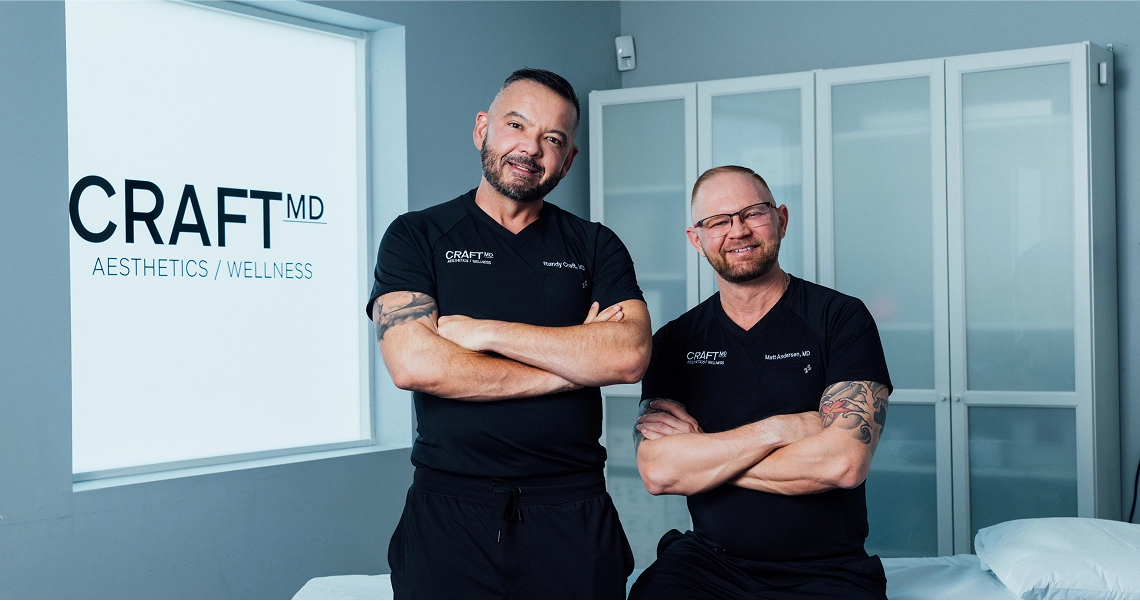
A photograph of two doctors, Dr. Randy Craft (left) and Dr. Matt Anderson (right), standing side-by-side in what appears to be a consultation or treatment room. Both men are smiling, have their arms crossed, and are wearing black scrubs embroidered with the "CRAFT MD" logo and their respective names. Behind them is a large, illuminated sign in a window that reads "CRAFT MD AESTHETICS / WELLNESS", and a wall of white glass-front cabinets.

Our Ethos

Why Choose Dr. Anderson?

Dr. Matthew Andersen is a board-certified anesthesiologist who leads men’s wellness at CraftMD. Precision with a needle is what he has done every working day of his career—and it’s why every injection here is placed under ultrasound guidance rather than by feel.

Every consultation is a conversation about what’s causing the problem, what your options genuinely are, and what each one is realistically likely to do for you.

PRP Therapy for Erectile Function FAQ’S

Schedule

Your

To schedule your consultation, please call our Phoenix, AZ office at (602) 786-6975 or complete the online form.